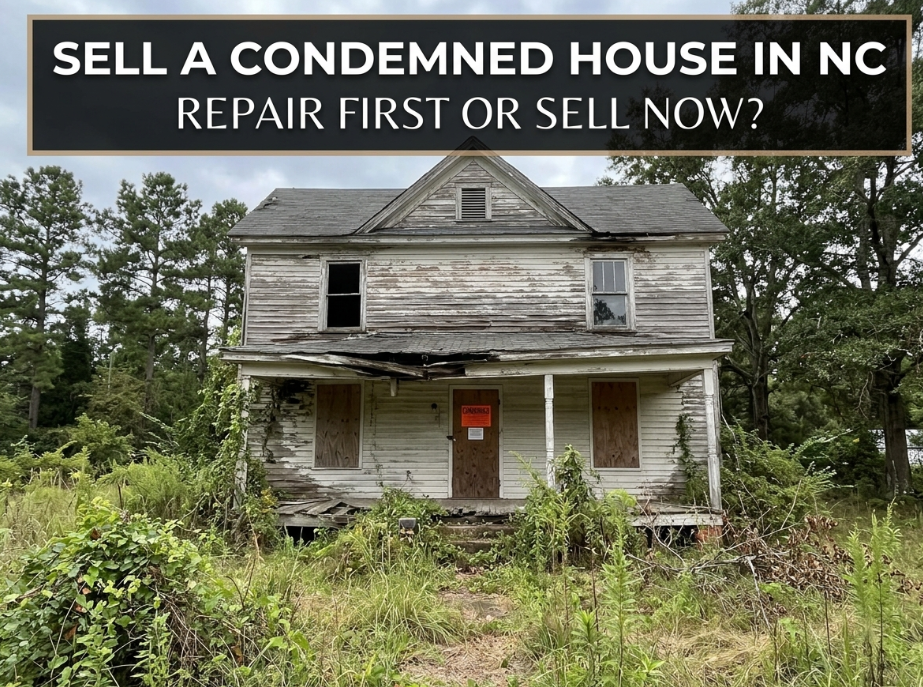
How to Sell a Condemned House in North Carolina: Repair It or Sell As-Is?
You can sell a condemned house in North Carolina because an unsafe-building or minimum-housing order does not automatically erase ownership. The real decision is whether repairing the violations will preserve more equity than selling as-is before deadlines, demolition costs, liens, taxes, insurance, and holding expenses grow.
Start with four facts:
- What the condemnation order requires
- The deadline to repair, close, vacate, or demolish
- Realistic repair and permit costs
- The property’s as-is and after-repair value
A Condemned House Is More Than a House That Needs Repairs
Selling a condemned house is different from selling an ordinary fixer-upper. A local inspector or housing authority has formally found the structure unsafe, unfit for habitation, or in violation of applicable safety standards.
Common triggers include:
- Structural failure or severe decay
- Dangerous electrical or heating systems
- Fire damage
- Unsafe walls, floors, or exits
- Serious sanitation or utility problems
- Code violations creating health or safety risks
North Carolina law allows local governments to order repair, closing, or demolition of dwellings found unfit for human habitation. The actual local order controls your next step.
What Happens When a House Is Condemned in North Carolina?
If you are asking what happens when a house is condemned, start with the notice or order. It should identify the violations, required corrective action, hearing rights, and deadlines applying to the property.
Possible next steps include:
- Repairing the cited conditions
- Vacating and closing the structure
- Attending or requesting a hearing
- Demolishing the building when required
- Selling before enforcement progresses
Do not assume another owner’s timeline applies. North Carolina’s minimum-housing and unsafe-building laws give local governments enforcement authority, while cities and counties administer their own procedures.
Can You Sell a Condemned House in NC Before Repairs?
Yes, you can sell a condemned house in NC in many situations, but the buyer must evaluate the active order, occupancy restriction, repair obligations, municipal deadlines, and any charges or liens affecting title.
A buyer may price:
- Land value
- Remaining structural value
- Cost to cure violations
- Demolition cost
- Permit requirements
- After-repair value
- Existing mortgages, taxes, or liens
The transaction is usually closer to a distressed-property sale than a normal move-in-ready home sale.
Can a Condemned House Be Fixed?
Can a condemned house be fixed? Sometimes. Condemnation does not always mean demolition is the only economical answer. Some houses need targeted safety work, while others need extensive structural rehabilitation.
Before choosing repair, get:
- Written contractor estimates
- The complete violation list
- Permit requirements
- Structural or engineering input when needed
- Reinspection requirements
- A contingency for hidden damage
Opening walls or correcting fire, foundation, electrical, or water problems can reveal additional work, so the first estimate should not be treated as the final cost.
Repair It or Sell As-Is? Compare the Equity
When deciding how to sell a condemned house, compare what you could actually keep after repair costs, carrying costs, debt, and transaction expenses, not just which path has the higher sale price.
Decision Factor |
Repair First |
Sell As-Is |
| Upfront cash | Usually higher | Usually lower |
| Time | Longer | Potentially shorter |
| Buyer pool | May expand after compliance | Mostly specialized buyers |
| Construction risk | Owner carries it | Buyer prices it in |
| Potential price | Higher if repairs succeed | Lower due to condition |
A renovated sale can produce a higher price yet leave less equity if rehabilitation absorbs too much cash.
Repair Costs Must Be Compared With After-Repair Value
A homeowner trying to sell a condemned house should calculate the repair spread before committing money. Start with realistic after-repair value, then subtract everything required to reach compliant, marketable condition.
Include:
- Labor and materials
- Engineering or design work
- Permits and inspections
- Utility reconnection
- Debris removal
- Taxes and insurance during work
- Financing costs
- Hidden-condition contingency
- Selling expenses afterward
If the projected equity gain is thin, one major change order can erase the advantage of repairing first.
The Municipal Deadline Can Change the Decision
A repair plan can make financial sense and still fail if the condemned house is already under a tight compliance or demolition schedule. Local enforcement timing matters as much as the rehabilitation budget.
Ask the issuing department:
- What is the next deadline?
- Is a hearing scheduled?
- Can an extension be requested?
- What proves repair progress?
- Has a demolition order been recorded?
- Have enforcement costs begun?
North Carolina law also allows certain government-incurred repair, closing, removal, or demolition costs to become liens against property. Waiting without a workable plan can therefore reduce equity.
Financing and Disclosure Can Narrow the Buyer Pool
Standard buyer financing may be difficult when selling a condemned house because active safety problems can affect appraisal, insurance, occupancy, and lender property requirements. Cash, rehabilitation, or specialized buyers may become more practical.
Also organize:
- Condemnation notices
- Inspection reports
- Code letters
- Repair estimates
- Existing permits
- Municipal correspondence
- Proof of completed corrective work
North Carolina disclosure law applies to many residential sales, subject to statutory exemptions. North Carolina residential property disclosure requirements should be reviewed carefully, especially when known structural or safety conditions exist.
An As-Is Sale Does Not Cancel the Condemnation
An as-is contract changes who will handle future repairs, but it does not erase an unsafe-building order. A buyer purchasing a condemned house as-is will price the order, deadline, demolition exposure, and repair scope into the offer.
For owners who do not want to manage rehabilitation, Fix It Money’s as-is home sale options can be compared with repairing first. The live service covers Carolina properties with structural damage, mold, fire or water damage, and code violations.
Compare a Cash Offer With the Cost of Waiting
If you want to sell a condemned house for cash, compare a firm as-is offer with the realistic net result of fixing and listing. Do not compare it only with an ideal future retail price.
Use one worksheet:
- Current mortgage and liens
- Current property value
- Repair budget
- Holding period
- Taxes and insurance
- Enforcement or demolition costs
- Selling expenses
- Expected closing date
- Estimated net proceeds
Fix It Money’s How It Works process explains how property condition and repair costs are considered when reviewing a direct sale.
When Repairing the Condemned House Makes More Sense
Repairing may be stronger when the violations are clearly defined, the structure has solid underlying value, funding is available, and the expected equity gain comfortably exceeds the rehabilitation risk.
Repair is more attractive when:
- Contractor bids are dependable
- The scope is manageable
- The municipality allows enough time
- Permits can be obtained
- After-repair demand is strong
- A contingency reserve remains
The goal is not just removing the placard. The completed property should justify the money, time, and risk invested.
When Selling As-Is Deserves Serious Consideration
An as-is sale can be more practical when selling a condemned house would otherwise require unavailable cash, complex rehabilitation, or months of code-enforcement and carrying-cost exposure.
Compare a sale when:
- Structural repairs are extensive
- Several major systems have failed
- The compliance deadline is short
- The property is vacant
- Insurance is difficult
- Taxes or liens are growing
- You do not want construction risk
Owners can also review Fix It Money’s Carolina property options rather than repairing solely to make the property listable.
Make the Decision From Net Equity and the Official Order
To sell a condemned house well, start with the legal status and end with the financial outcome. Confirm the order and deadlines, estimate repairs honestly, calculate liens and carrying costs, then compare net proceeds under both paths.
The stronger option is the one that protects more usable equity with a level of time, cash, and risk you can realistically manage. If the numbers are close, certainty and enforcement timing may matter more than the headline sale price.
Five Direct-Answer Questions
Can you sell a condemned house in North Carolina?
Yes. In many North Carolina cases, the owner can sell while a condemnation order is active, but the buyer must accept the property’s condition, restrictions, and deadlines.
Should you repair a condemned house before selling?
Sometimes. Repair makes more sense when the violation scope is clear, costs are controlled, deadlines allow the work, and expected equity gains comfortably exceed renovation risk.
Can a buyer finance a condemned house?
Often it is difficult. A condemned property may fail normal appraisal, insurance, occupancy, or condition requirements, so cash buyers or specialized rehabilitation buyers can be more realistic.
Can demolition costs become a lien in North Carolina?
Yes. If local government performs qualifying authorized repair, closing, removal, or demolition work, those costs can become a property lien and reduce future sale proceeds.
How do you choose between repairing and selling as-is?
Compare repairs, permits, holding costs, enforcement deadlines, after-repair value, as-is value, mortgages, liens, selling expenses, and expected net proceeds before committing to either route.