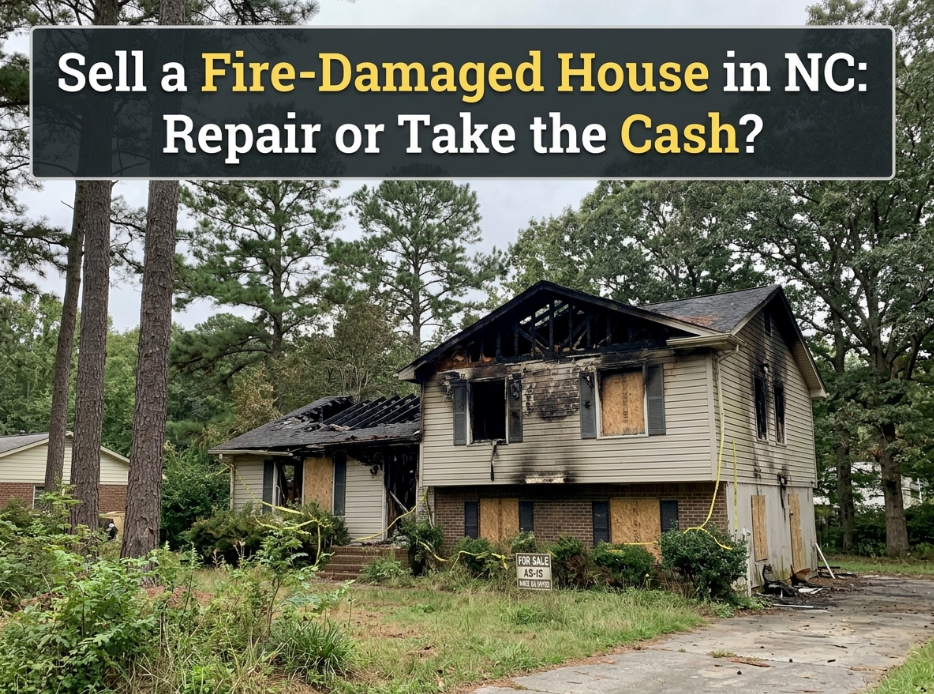
Sell Fire-Damaged House in NC: Keep the Insurance Money or Rebuild First?
You can sell a fire-damaged house in North Carolina before rebuilding, but the insurance money is not automatically free cash. Your policy, mortgage lender, claim status, and replacement-cost rules can change what you actually control. Compare confirmed insurance recovery, the rebuild gap, an as-is offer, carrying costs, and mortgage payoff before choosing a path.
Start with five numbers:
- Actual cash value already paid or confirmed
- Replacement-cost benefits still recoverable
- Full restoration estimate
- Mortgage and lien payoff
- Realistic as-is sale proceeds
Separate the Insurance Claim From the Property Sale
When selling a house with fire damage, treat the insurance claim and real estate sale as related but separate financial events. The buyer pays for the property, while the insurer pays according to your policy and covered loss.
Confirm before listing:
- Payments already issued
- Amounts still tied to repair or replacement
- Whether your lender is named on the check
- Insurer inspections or documents still required
- How a sale affects unpaid claim benefits
That keeps you from counting money that may still depend on policy conditions or lender approval.
Actual Cash Value and Replacement Cost Are Different
North Carolina’s Department of Insurance distinguishes actual cash value from replacement cost value. ACV reflects repair or replacement cost after depreciation. Replacement-cost coverage may reimburse additional amounts after qualifying repair or replacement.
If you sell a house with fire damage instead of rebuilding, review:
- ACV already received
- Recoverable depreciation
- Policy limits and deductible
- Code-upgrade coverage
- Contents coverage
- Temporary living-expense benefits
Do not assume the full replacement-cost estimate becomes cash simply because you decide to sell. Review the North Carolina DOI explanation of ACV and replacement cost before relying on the full claim estimate.
Your Mortgage Lender May Control Part of the Claim
If the home has a mortgage, the lender may be named as a payee on the insurance check. North Carolina DOI guidance explains that lenders can have an interest in repair or rebuilding funds.
If you need to sell my fire-damaged house, ask the lender:
- How much of the claim it controls
- What releases repair funds
- Whether payments come in draws
- What happens when the mortgage is paid at closing
- What happens to remaining claim funds
Get those answers before building a sale plan around the insurance check.
Rebuild First or Sell Now? Compare the Same Outcome
The right choice is not the path with the highest sale price. Compare what remains after restoration, insurance recovery, selling costs, debt payoff, and time.
Decision Factor |
Rebuild Then Sell |
Sell in Current Condition |
| Upfront coordination | High | Lower |
| Contractor risk | Seller carries it | Buyer prices it |
| Retail buyer access | Usually broader | Often narrower |
| Time before sale | Longer | Potentially shorter |
| Sale price | Usually higher | Usually lower |
This keeps selling fire-damaged house decisions focused on net recovery rather than the largest headline number.
Price Damage Beyond the Burned Room
Fire restoration is rarely limited to visibly burned material. Smoke, soot, firefighting water, heat, and open-roof exposure can create costs far beyond the room where the fire started.
A full scope may include:
- Framing and roof structure
- Electrical wiring and panels
- Plumbing
- HVAC and smoke contamination
- Insulation and drywall
- Water intrusion and mold risk
- Debris removal
- Permits and inspections
If how to sell a fire-damaged house is the question, this wider scope matters because both contractors and buyers price hidden risk.
Calculate the Rebuild Gap Before Spending the Claim
The insurer’s estimate and contractor bids may not match. Deductibles, depreciation, limits, code upgrades, uncovered work, or newly discovered damage can create an out-of-pocket gap.
Use this check:
Confirmed insurance funds available for repairs
minus total restoration and code-compliance cost
minus extra housing and carrying costs
equals rebuild surplus or shortfall
If the result is negative, rebuilding only to sell requires additional cash that the higher sale price must recover.
Rebuilding Makes Sense When Insurance Covers the Real Scope
Rebuilding can be stronger when damage is repairable, insurance covers most verified work, the timeline is manageable, and the finished home can return to a broader buyer market.
Repair first is more attractive when:
- Contractor scopes are consistent
- Structural damage is manageable
- Insurance coverage is strong
- Recoverable depreciation is meaningful
- Holding costs are affordable
- Expected repaired value leaves a healthy equity margin
The rebuild should improve total financial recovery enough to justify construction time and risk.
Selling Before Rebuilding Can Limit an Expanding Project
An as-is sale may be more practical when damage is severe, the claim is complicated, or opening walls keeps revealing more work. The buyer then prices restoration risk into the offer.
Fix It Money’s as-is home sale options include North Carolina properties with fire or water damage and do not require repairs first.
Consider selling in current condition when:
- The restoration gap is large
- You cannot fund the shortfall comfortably
- Temporary housing and carrying costs are growing
- You do not want to manage contractors
- A written as-is offer produces competitive net proceeds
Do Not Compare an As-Is Offer With the Pre-Fire Value
A common mistake when owners sell a fire-damaged house is comparing an investor offer with the home’s pre-fire value. Those are not equivalent numbers.
Compare instead:
- Expected repaired sale price
- Unreimbursed repair costs
- Agent compensation and seller costs
- Mortgage, HELOC, and lien payoffs
- Property taxes and utilities
- Construction timeline
- As-is offer and contract terms
Our cash offer calculation guide shows why repair costs and after-repair value should be separated from mortgage payoff and final net proceeds.
Keep the Fire Report, Claim File, and Repair Records Together
Documentation can reduce buyer uncertainty about whether you rebuild or sell a fire-damaged house as-is. A buyer can price a documented problem more confidently than an unexplained damaged structure.
Keep:
- Fire department report
- Insurance estimates and payment records
- Contractor bids
- Structural, electrical, or HVAC reports
- Permits and repair invoices
- Inspection sign-offs
- Before-and-after photos
Do not enter an unsafe building just to collect records. Follow fire officials, your insurer, and qualified professionals on safe access.
North Carolina Disclosure Rules Still Matter After Repairs
North Carolina’s Residential Property Disclosure Act requires a disclosure statement for many residential transfers and allows sellers to answer based on actual knowledge or select “no representation” for covered conditions. Licensed brokers have separate material-fact duties.
For selling a fire-damaged house, repaired finishes do not erase known history. Keep documentation and discuss the specific disclosure approach with your broker or a North Carolina real estate attorney.
Compare What You Keep, Not Just What You Receive
To decide whether to rebuild or sell a fire-damaged house property now, calculate total recovery from all sources, including insurance benefits you can actually retain, sale proceeds, repairs, debt payoff, and waiting costs.
Rebuild path: insurance recovery + repaired-sale proceeds – unreimbursed repairs – holding and selling costs – debt payoff
Sell-now path: insurance benefits you are entitled to retain + as-is sale proceeds – debt payoff – transaction costs
Fix It Money’s property review process can provide a direct-sale number based on condition, repair costs, and market value. Use it as one side of the comparison, not the automatic answer.
Choose the Path That Preserves the Stronger Net Recovery
You can sell a fire-damaged house in North Carolina without completing a rebuild first. The harder question is whether selling changes insurance benefits, lender control, or the equity you ultimately keep.
Confirm claim terms, mortgage-payee rules, repair scope, and realistic sale numbers before committing insurance money to construction. Rebuild when covered recovery and repaired value justify the project. Sell in current condition when the restoration gap, time, and risk consume too much of the upside.