
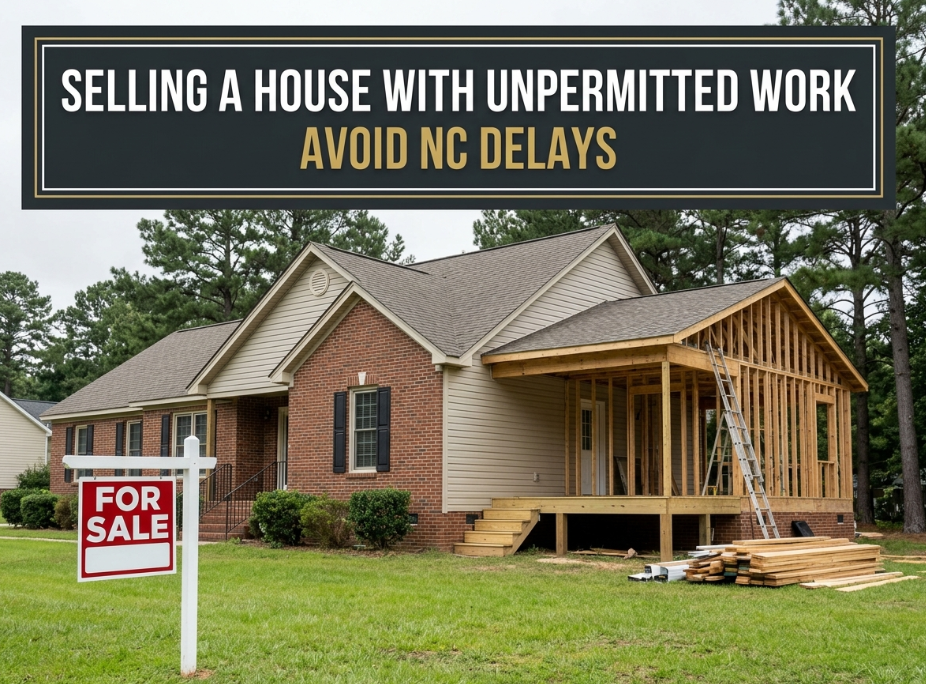
Selling a House With Unpermitted Work in North Carolina: What Can Derail the Closing?
Selling a house with unpermitted work in North Carolina is usually possible, but the missing permit is only part of the risk. Closing gets harder when work never passed inspection, changes legal living space, violates zoning, creates a safety concern, or leaves the buyer’s lender unable to verify value and marketability.
Before listing, pin down four facts:
- Was a permit required?
- Was it issued and finalized?
- Is the current use legal?
- What would approval, removal, or an as-is sale cost?
Can You Sell a House With Unpermitted Work in NC?
Yes. Can you sell a house with unpermitted work? Often you can. The real question is what that work changes about safety, code compliance, appraisal, financing, insurance, and buyer confidence.
A finished basement with no final inspection creates a different problem from unsafe wiring or a garage conversion that conflicts with zoning.
First Check Whether the Work Actually Needed a Permit
Do not call a renovation illegal just because paperwork is missing. North Carolina requires permits for many structural, electrical, plumbing, HVAC, roofing, and construction projects, but some work is exempt.
Ask the local inspection department:
- What rules applied when the work was done?
- Does the address show a permit?
- Was the project exempt?
- Is there an open or expired permit?
- Is final approval recorded?
North Carolina law sets the framework, while the local city or county administers permits and inspections.
Put the Problem Into the Right Permit Category
Permit status |
What it means |
Seller’s next question |
| No permit required | Missing paperwork may be harmless | Can the exemption be documented? |
| Required permit never obtained | Work skipped required review | Can it receive after-the-fact approval? |
| Permit expired | Approval process stopped | What inspections or new permit are needed? |
| Permit not finalized | Final inspection may be missing | What closes the permit? |
| Zoning or occupancy conflict | Use itself may be restricted | Can the current use legally continue? |
This distinction is central to selling a house with unpermitted work because each problem needs a different fix.
Pull the Permit History Before the Buyer Does
A clean permit history gives you time to solve problems before due diligence. Search the local record by property address and match permits to the improvement.
Gather:
- Building and trade permits
- Inspection results
- Final inspection records
- Certificate of compliance or occupancy
- Contractor invoices
- Engineering plans or letters
- Zoning or code-enforcement notices
If a previous owner completed the work, document that too. The permit issue can still affect the property even when you did not create it.
An Expired Permit Is Not the Same as No Permit
An expired permit means a permit existed, but the process was not completed. North Carolina law says permits can expire when work does not begin or remains discontinued for the statutory period.
Ask the jurisdiction:
- Which inspections were completed?
- Which inspection was missed?
- Is a replacement permit required?
- Must finished work be exposed?
- What document confirms final approval?
A permit number alone does not prove that the project passed final inspection.
Hidden Work Can Turn Paperwork Into Construction Cost
The expensive part of selling a house with unpermitted work often appears when an inspector cannot verify framing, wiring, plumbing, insulation, or structural connections behind finished surfaces.
Possible requirements include:
- Opening drywall
- Exposing electrical or plumbing work
- Hiring a licensed contractor
- Obtaining an engineer’s letter
- Correcting code deficiencies
- Removing part of the improvement
Get the local inspection department’s requirements before promising a buyer that retroactive approval will be simple.
Unpermitted Square Footage Does Not Automatically Equal Zero Value
An unpermitted addition can affect an appraisal, but Fannie Mae does not say every such improvement automatically receives zero value. The appraiser must address the quality and appearance of the work and any impact on market value.
That creates four questions:
- Is the construction sound?
- Is the current use legal?
- Does the market recognize the improvement?
- Will the lender accept the appraisal?
A well-built addition and a noncompliant bedroom are not the same valuation problem.
Financing Problems Usually Start With Uncertainty
A mortgage can slow down when underwriting cannot verify safety, legal use, insurability, or the value assigned to an unpermitted improvement.
A financed buyer may request:
- Permit resolution
- Contractor or engineer evaluation
- Removal of unsafe work
- Different appraisal treatment
- Additional lender review
A cash buyer removes mortgage underwriting, but it does not erase zoning, disclosure, or future enforcement risk.
Zoning Can Be a Bigger Problem Than the Permit
Some sellers focus only on building permits and miss legal use. A garage conversion, second kitchen, accessory unit, or added bedroom may raise zoning or occupancy questions even if construction can be inspected.
Check both offices:
- Building department: Was the work properly constructed and inspected?
- Planning or zoning: Is the current use allowed?
A retroactive building permit does not automatically make a prohibited use legal.
North Carolina Disclosure Needs Accurate Facts
North Carolina’s disclosure framework addresses structural changes, building codes, zoning, and land-use restrictions. Brokers also have separate material-fact duties. NCREC advises brokers to verify permits when renovations, additions, or repairs raise concerns.
Do not guess that work was permitted, code-compliant, or approved when the records do not support that statement.
What Happens If You Sell a House With Unpermitted Work?
What happens if you sell a house with unpermitted work depends on when the issue appears and how serious it is.
Closing problem |
Possible result |
| Missing final inspection | Buyer requests completion |
| Unsafe wiring or framing | Repair or professional evaluation |
| Unapproved living area | Value may change |
| Zoning conflict | Current use may need to stop |
| Active enforcement case | Buyer prices correction risk |
| Late discovery | Renegotiation or closing delay |
Finding the problem before listing gives the seller more control.
Decide Whether to Legalize, Remove, or Leave It
An after-the-fact permit or local retroactive approval process may make sense when the improvement adds real value and corrections appear manageable. Removal may be smarter when the feature is unsafe, low-value, or expensive to approve.
Compare three numbers:
- Cost to legalize and correct the work
- Cost to remove or restore it
- Value the improvement realistically adds
If the house also needs major physical work, compare the permit issue with the major-repair sale strategy before spending heavily.
Can I Sell a House With Unpermitted Work As-Is?
Potentially, yes. Can I sell a house with unpermitted work without legalizing everything first? An as-is buyer may accept the property in its current condition, but the permit issue should still be clearly defined.
Fix It Money’s as-is home-sale process covers properties with repairs and unfinished renovations. Its property review process evaluates the house in its present condition rather than requiring renovation first.
Ask the buyer:
- Is the offer assuming legalization or removal?
- What correction cost is being deducted?
- Is questionable square footage given value?
- Can the offer change after inspection?
- Who handles open permits after closing?
A specific permit deduction is easier to evaluate than a vague discount for “risk.”
How to Sell a House With Unpermitted Work Without Losing the Closing
The strongest approach to selling a house with unpermitted work is to reduce uncertainty before the buyer’s lender discovers it.
Before accepting an offer:
- Verify whether a permit was required.
- Pull permit and inspection records.
- Separate expired permits from never-permitted work.
- Confirm zoning and legal use.
- Estimate legalization and removal costs.
- Gather contractor or engineering documents.
- Compare financed and as-is buyer routes.
For Raleigh-area properties, Fix It Money’s Raleigh direct home-buying option gives sellers another comparison when they do not want to complete the permit process first.
The goal is not to make every old renovation perfect. It is to know what the improvement is, what the local authority requires, and how that affects market value, financing, closing risk, and realistic net proceeds.
FAQs
Can You Sell a House With Unpermitted Work in North Carolina?
Yes, usually. First determine whether a permit was required, identify open inspections or code issues, confirm legal use, and understand how the buyer plans to finance the property.
What Happens if the Previous Owner Did the Unpermitted Work?
The issue can still affect your sale because the improvement remains with the property. Pull the permit history, document known facts, and ask the local jurisdiction what remains unresolved.
Will an Appraiser Count an Unpermitted Addition?
Potentially. Fannie Mae requires the appraiser to consider the addition’s quality, appearance, and impact on market value rather than automatically assigning every unpermitted improvement zero value.
Can I Sell a House With Unpermitted Work As-Is?
Possibly. An as-is sale can transfer correction work to the buyer, but it does not eliminate zoning, disclosure, appraisal, safety, financing, or code-enforcement concerns.
Should I Get a Retroactive Permit Before Selling?
Consider approval when the improvement adds meaningful value and corrections are manageable. If legalization requires substantial reconstruction, compare removal costs and an as-is sale before spending heavily.