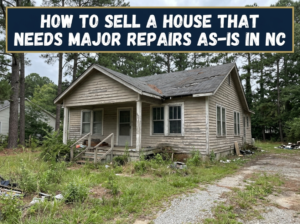
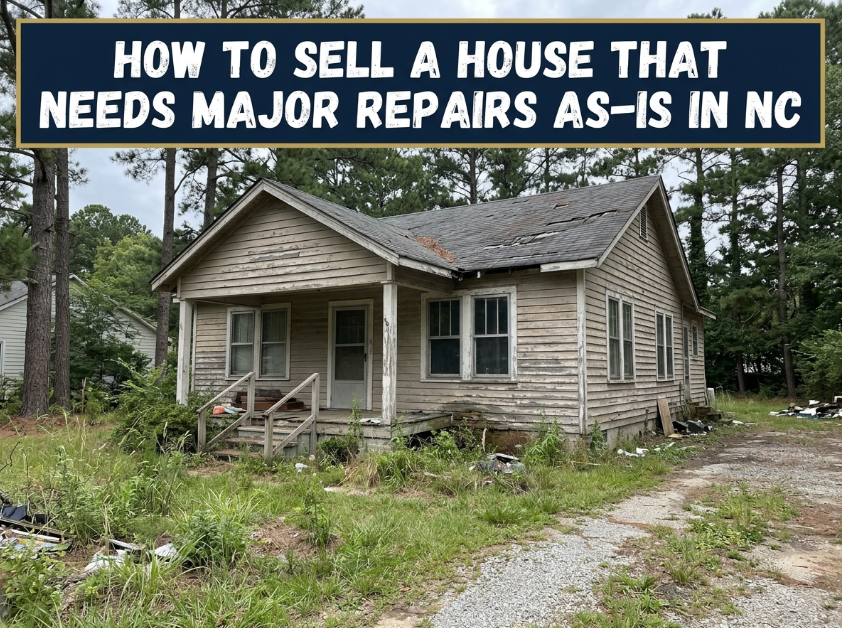
How to Sell a House That Needs Major Repairs in North Carolina
If you need to sell a house that needs major repairs, you do not have to fix everything first. In North Carolina, the practical choices are targeted repairs, qualifying for repair funding, an as-is listing, or a direct sale in the home’s current condition. The right choice depends on repair cost, available cash, buyer financing, timeline, and expected net proceeds.
Start with four numbers:
- Current as-is value
- Estimated after-repair value (ARV)
- Real repair cost
- Mortgage and lien payoff
Separate Major Repairs From Cosmetic Work
A dated kitchen is not the same problem as a failing roof or shifting foundation. Major repairs affect safety, structural integrity, insurability, financing, or basic function. Cosmetic work mainly affects presentation.
Major repair examples include:
- Active roof leaks or severe roof deterioration
- Foundation movement or structural damage
- Failed HVAC, plumbing, or electrical systems
- Water intrusion, mold, or fire damage
- Septic, well, or major drainage problems
- Extensive deferred maintenance
Paint or countertops will not solve a defect that blocks financing or keeps damaging the property.
Can You Sell a House That Needs Major Repairs As-Is?
Yes. Selling a house that needs major repairs does not require renovating it first. You can list as-is, market to renovation-minded buyers, or consider a direct buyer that prices the work into the offer.
An as-is sale means the seller is not agreeing to complete repairs simply because the property needs them. Buyers can still inspect, negotiate, or decide the condition does not fit their financing.
Fix It Money’s as-is home-sale options include foundation issues, leaking roofs, mold, termites, fire or water damage, and unfinished properties.
Some Major Repairs Can Reduce the Financed Buyer Pool
A serious defect can affect more than buyer preference. It can affect buyer financing. Fannie Mae requires appraisers to identify conditions affecting safety, soundness, or structural integrity. A property rated C6 is not eligible for sale to Fannie Mae until those deficiencies are repaired.
Property condition |
Likely sale impact |
|---|---|
| Cosmetic wear | Usually affects presentation and price |
| Significant but functional deferred maintenance | May still finance, depending on appraisal and lender |
| Active roof leak or major system failure | May trigger repair requirements |
| Safety or structural defect | Can materially restrict conventional financing |
| Severe C6-level condition | Must be repaired before Fannie Mae eligibility |
The current Fannie Mae property-condition guidance explains why a damaged house can attract a buyer yet still struggle at appraisal or underwriting. FHA transactions can also involve HUD property standards and appraisal requirements.
What If You Cannot Afford the Repairs?
If your house needs major repairs and you want to sell, a lack of cash does not leave only one path. Compare the cost, time, and risk of each route before borrowing or accepting an offer.
Option |
Best fit |
Main trade-off |
|---|---|---|
| Make targeted repairs | One or two problems block financing | Requires upfront cash |
| Use qualifying property-based funding | Equity exists and improving the house still makes sense | Adds financing cost and obligations |
| List as-is | Time is available, and local buyers accept projects | Smaller buyer pool and negotiations |
| Direct as-is sale | Repairs are extensive, or cash is limited | Offer reflects repair cost and buyer risk |
The site’s qualifying Carolina property solutions can include fix-up funds, so repair funding may deserve comparison before assuming a sale is required.
What Is the Best Way to Sell a House That Needs Major Repairs?
The best way to sell a house that needs major repairs is the route that produces the strongest realistic result after repairs, delays, selling expenses, and risk. The highest projected sale price is not automatically the highest net result.
Use this comparison:
Repaired sale price – repair cost – holding costs – selling costs – debt payoff = estimated net proceeds
Then compare that figure with an actual as-is offer or realistic as-is listing result.
A repair-first plan can look attractive until months of mortgage payments, taxes, insurance, utilities, contractor overruns, and buyer-requested repair credits are added.
Repair Only What Changes the Outcome
When money is limited, repairs should solve a specific problem. A repair may be worth considering if it stops active damage, removes a financing barrier, improves safety, or adds more value than it costs.
Question these expenses first:
- Full kitchen or bathroom remodeling
- New flooring throughout
- Cosmetic landscaping
- Decorative fixtures
- Premium finishes
A roof leak that keeps damaging ceilings is different from dated cabinets. Spend first on conditions that change marketability or prevent further damage.
Selling As-Is Does Not Mean Hiding Known Defects
North Carolina sellers should separate the decision not to repair from the duty to deal honestly with known property problems. The North Carolina Real Estate Commission warns that sellers can face liability for knowingly concealing or misrepresenting material latent defects.
The NCREC guidance on latent defects explains the state’s disclosure framework for covered residential transactions, subject to applicable exemptions.
Keep useful records such as:
- Inspection reports
- Contractor estimates
- Structural or engineering reports
- Insurance claim documents
- Code notices
- Repair invoices and warranties
If you are unsure what must be disclosed, ask a North Carolina real estate professional or attorney.
Know the Real Repair Scope Before Spending
One estimate can be misleading when several systems are failing. Foundation movement may also damage plumbing, drywall, doors, flooring, or drainage. Roof leaks may lead to sheathing, insulation, or moisture work.
Before choosing to repair, identify:
- What must be fixed now
- What can safely wait
- Which work requires permits
- Whether the repair affects insurance
- Whether completion changes buyer financing
- How long contractors need
You need enough information to compare the repair route with selling in the property’s present condition.
How to Sell a House That Needs Major Repairs Step by Step
If you decide to sell a house that needs major repairs, make the condition part of the plan instead of letting it become a surprise after contract.
Use this sequence:
- List known roof, foundation, HVAC, plumbing, electrical, moisture, and structural problems.
- Gather reports or estimates you already have.
- Estimate current value and after-repair value separately.
- Calculate mortgage, taxes, liens, and other payoffs.
- Compare repair-first, as-is listing, and direct-sale numbers.
- Confirm disclosure and title requirements.
- Choose the route that fits your cash, timeline, and expected proceeds.
The property review process lets Carolina owners discuss a property without first cleaning or repairing it.
When a Direct As-Is Sale May Make More Sense
A direct sale deserves consideration when the repair bill exceeds available cash, several major systems have failed, conventional financing may be difficult, or managing contractors would create more risk than value.
It can also fit an inherited, vacant, rural, or heavily damaged home where certainty matters more than maximizing the repaired retail price.
Fix It Money buys qualifying Carolina properties as-is and says sellers do not need to repair or clean them first. Compare any offer with repair costs, expected market value, liens, and other selling routes.
Choose the Option That Protects Your Equity
If you need to sell a house needing major repairs, start by asking which repairs actually change the financial result, not how much a complete renovation would cost.
Put these numbers side by side:
- As-is value
- After-repair value
- Repair budget
- Holding costs
- Selling expenses
- Mortgage and liens
- Time needed to finish the work
If targeted funding creates a better outcome, repairing may make sense. If repairs consume cash without producing enough added value, an as-is sale may be cleaner. The goal is a decision that protects usable equity with the time and money you actually have.